Lent is the fasting period of forty days which precedes Easter, set aside by Holy Mother Church as a time of penance for our sins.
The practice of fasting and abstinence is accepted by every nation of the world as a universal veneration and a means to appease God's justice by man subjecting his body to penance.
As stated in The Liturgical Year by Dom Gueranger, the Lenten period is to emulate Our Lord’s time in the desert when He withdrew from the company and sight of men in which time Our Lord prayed, and fasted. We are to think over our past sins and bewail them in bitter grief. We will assist at Mass more assiduously and pray more fervently than at other times. After the forty days and nights in the desert, Our Lord begins His preaching with these words, “Do penance for the Kingdom of Heaven is at hand” for “unless you do penance you shall perish.”
Penance consists in the contrition of the soul and the mortification of the body as the soul willed the sin, the body has frequently co-operated in its commission.
How should we fast?
For our Lenten fast to be efficacious there are three conditions which must be met as Saint Francis de Sales tells us in his Sunday Sermons.
Firstly we must fast with our whole heart, that is willingly, wholeheartedly, universally and entirely. Saint Bernard says that fasting was instituted by Our Lord Jesus as a remedy for our mouth, for our gourmandising and our gluttony, for it is through our mouth that sin entered the world and therefore the mouth must do penance. He adds that our other senses have also sinned and therefore must also do penance and therefore all our senses must fast. And not only our bodily senses, but also our soul’s powers and passions and even the understanding, the memory and the will since we have sinned through both the body and the spirit.
The second condition is to fast through both humility and charity for if you have not charity, you have not humility. These two virtues go hand in hand. To fast through humility you fast as is prescribed by God’s laws, no more, no less. Saint Paul in his Epistles says to the Corinthians [1 Cor 13] we are to fast with charity or it will be displeasing to God. All works, small or large are of no value if not done with and through charity. Saint Paul in his Epistle to the Romans [Rom 14:1-6] says there are two groups of people who fast without humility. The first fast less than they ought, complaining that what is allowed is not enough. The second fast more than is necessary, fasting through vanity, not humility. They fast through their own self will which is not pleasing to God.
The great Saint Augustine says not to appear more than others when fasting such as the spider who weaves her web amongst the trees for all to see. Instead, be as the bees who prepare their honey in the hive where no one can see. They build little cells where they continue their work in secret. This represents the humble soul very well, who withdraws herself, not seeking glory or praise; rather being content that God sees and knows what she does. This is how we are to fast and do all things.
Our Lord tells us that we are not to look gloomy and melancholy, so as to be praised by others [Matt. 6:16-18] as the pharisees do. But let your fasting be done in secret; therefore wash your face and anoint your head and your heavenly Father Who sees all that is in your heart will reward you well. But we observe the fast in order to edify others in their observance of the fast as Saint Paul says [Phil. 4:5]: Let your modesty be known to all, in order that we edify each other.
The third condition is to look to God and to do everything to please Him alone. Cassian, that great Father of the spiritual life, teaches us so well in his admirable book, Conferences, wherein he says, "What will it profit you to do what you are doing for the eyes of creatures? Nothing but vanity and complacency, which are good for Hell alone. But if you keep your fast and do all your works to please God alone, you will labour for eternity, without delighting in yourself or caring whether you are seen by others or not, since what you do is not done for them, nor do you await your recompense from them. We must keep our fast with humility and truth, and not with lying and hypocrisy—that is, we must fast for God and to please Him alone."
The Gospel tells us that after Our Lord had overcome His enemy and rejected his temptations, angels came and brought Him heavenly food [Matt.4:16]. We will not share in Our Lord’s consolations and keep His company if we do not share in His labours and sufferings. We shall not rise with Him if we do not suffer and are not crucified with Him.
The observance of fasting and abstaining must be accompanied by prayer and alms-deeds.
Prayer consists of all those exercises of piety whereby the soul holds intercourse with God, such as more frequent attendance at Mass, spiritual reading, meditation upon eternal truths, including the Passion of Our Lord, hearing sermons and above all approaching the Sacraments of Penance and the Holy Eucharist.
Alms-deeds comprises of all the works of mercy to our neighbour. God has made it a law, to which He has graciously bound Himself, that charity shown towards our fellow creatures, shall be rewarded as though it were done to Himself. Alms-deeds lays up treasure in heaven for us.
In The Spiritual Life by Tanquerey, there are joys that come from practising penance. The Gospel for the Second Sunday of Lent will show us that penance has its joys once we have learned to perform it in the spirit of prayer and raise our eyes to God for His help. The Introit of the Fourth Sunday of Lent encourages us with, “Rejoice, O Jerusalem” enabling us to discern the joys of heaven, joys of which the Holy Communion, symbolised in the multiplication of loaves on Mount Thabor, gives us a foretaste.
History of Lent
The Lenten fast has changed since the birth of the Church with the Apostles. The original time for fasting was 36 days as the faithful did not fast on Sundays. It was later that four more days were added to the 36 days to emulate Our Lord who fasted for 40 days. The faithful of sound body were permitted one meal per day to be had before None, around 3pm, up to the 9th century. This was gradually relaxed both in and out of the cloister so that by the 13th century the fast can be broken by midday (The Liturgical Year pg. 6) as the lateness of the meal is not what is important rather that only one meal be taken. Over the centuries the amount of food taken increased to include two snacks, which, when combined, did not constitute a meal. The reason given that those who laboured were weakened by the fast and could not perform their duties.
The foods permitted and omitted during the Lenten fast have also undergone change. Prior to the 9th century the faithful abstained from eating milk-meats and eggs. But by the 17th century the faithful were permitted to eat these at various times and locations.
In a footnote we are reminded that by the new code of Canon Law (that being the 1917 Code), distinction is made between fasting and abstinence. All the weekdays of Lent, the Ember Days and some vigils are days of fasting but meat is allowed at the full meal except on Wednesdays and Fridays and the Ember Days in Lent. (N.B. The current fasting and abstinence rules vary in different regions, so one should refer to their local calendar, or clergy, to ascertain the relevant rules. The USA calendar can be obtained from Roman Catholic Media - and the Australian/Australasian calendar can be obtained from Mary Help of Christians Chapel, Victoria, Australia.)
As stated above, both the body and the soul are to be mortified during Lent as it is both which have sinned. It is for this reason many activities were prohibited during Lent. For this reason the Church limited activities and feasts within Lent.
To secure the calm and peace of heart which is needed for the soul’s self-examination, the Church limited and even prohibited certain activities during Lent. For instance, amusements such as hunting and theatrical entertainments were forbidden by the civil authority as well as law courts being closed. As early as AD 380 Emperor Gratian (367-383) enacted that the judges should suspend all law suits and proceedings during Lent as enacted by the Theodosian Code enforced on 1 January, 439 in the Eastern and Western parts of the Empire. In the ninth century, kings of the time were urged to enforce these canons.
Military activities were also suspended as enforced by the Emperor Constantine the Great in the fourth century on Sundays and Fridays as a means of respect for Our Lord Who suffered and arose on these days, so to not disturb the peace and repose needed to celebrate these days. The suspension of war was enacted in many countries in Christian Europe even up to the twelfth century.
The solemnisation of marriages was also forbidden during Lent.
In order to keep the mournfulness and austerity of Lent, for many centuries the Church admitted very few feasts. It has been only in the last few centuries that the Church has admitted several feasts in addition to the feast of Our Lady’s Annunciation on 25th March, such as including the feast of Saint Matthias on 24th February.
Some Significant days during Lent
Ash Wednesday: The first day of Lent when the faithful are marked with a cross on their forehead, using the ashes of the palms burned from the previous year’s Palm Sunday.
As stated in the Roman Missal, in the Old Law, ashes were generally a symbolic expression of grief, mourning or repentance.
In the early Church the ceremony was not originally for all Christians, but only for those who committed public sins or very serious scandalous sins for which public penance was required.
The penitents would gather as a group in the church where the faithful would be present. The priest would hear the accusations of the penitents who were dressed in sackcloth and have ashes sprinkled on their heads. All the faithful present would prostrate on the ground seeing the penitential souls. A procession would be formed where the penitents would walk barefoot then return to the church. Here the Bishop would perform a ceremony where the bishop would say to the penitents that they were driven out of the church as the first Adam was driven out of paradise because he transgressed, so they must leave the church and shut the doors. The penitents would not be allowed back into the church until Maundy Thursday (Holy Thursday). It was in the eleventh century when all the faithful received the ashes as a sign of humility.
The Mass for Ash Wednesday begins with the antiphon where the priest begs for mercy for himself and for all of the faithful gathered. The priest then recites the four blessing prayers over the ashes.
Each blessing refers to the purpose of the ashes. The first prayer asks for health of the body and protection of the soul. The second prayer, that we wear the ashes as a sign of humility and to obtain pardon of our sins. We also ask in the second prayer that those who do penance, that is, the penitent, may obtain by His mercy the promised rewards. The third prayer is to ask of Our Lord the spirit of compunction. In the third prayer we also ask that the servants of God may obtain what they justly ask for and that once things are obtained, they remain so. The fourth prayer asks that we may imitate the Ninevites who doing penance in sackcloth and ashes, were mercifully pardoned.
The dispositions we should have as we receive the ashes are; first to accept our sentence of death. We are made of dust and that we are all going to die. And as scary as that seems, we should wilfully accept it as a just punishment for our sins. Secondly we should humble ourselves because why would a pile of ashes exalt itself, to be proud and not submit to the laws of God, the laws of His Church? The life of man is like a pile of ashes which is dispersed in the wind. The life of man is short, living for the moment, not for eternity.
God requires that we be humble. Of ourselves we are convinced we are nothing and can do nothing for our own salvation. This is humility without confidence in God. True humility raises us up to confidence, so we distrust ourselves and have complete confidence in the Grace of God as we pray in the Antiphon. After all the faithful have received the ashes, the priest prays that the faithful remain courageous and generous in the combat against self, against sin and against demons.
The liturgy of Ash Wednesday humbles us, then lifts us up. It makes us think of our sins, our nothingness, our suffering, but then reminds us of the mercy of God in Whom we trust Who came, not to call the righteous, but to call sinners to repentance.
In the Gospel, Our Lord instructs His disciples in how to fast. Do not fast as the hypocrites who with their disfigured faces fast for other men for they have received their reward. But fast in such a way as to not appear to men to fast. Therefore anoint your head, wash your face so only your Father, Who is in secret, sees and He will repay thee with treasures in heaven where no rust, nor moth, nor thief can touch. For where thy treasure is, there is thy heart.
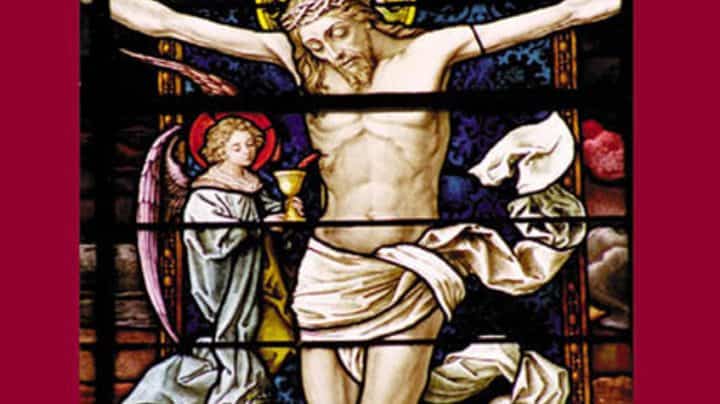
During the last two weeks of Lent we commemorate the Passion of Our Lord in Passion Week beginning with Passion Sunday, before the great crescendo of Lent in the Holy Triduum — Holy Thursday, Good Friday, and Holy Saturday. The Church acts out the Gospel for Passion Sunday on that same day: "They took up stones, therefore, to cast at him. But Jesus hid Himself, and went out of the Temple." (John 8:59). This season within a season, Passiontide, commemorates the events of Our Lord's sacred Passion, but does so with Our Lord hidden. The crucifixes, veiled in violet, along with images of our Lady and the Saints, hide as He did. (The Liturgical Year, Episode 8: Passiontide, St. Patrick, and Valid Matter for the Holy Eucharist February 24, 2015, True Restoration) The only statues which are not veiled are of the angels adoring. This is so we focus on Our Lord and His Passion.
Passion Sunday is the first day of Passiontide. As the Roman Missal states:
The Mass of Passion Sunday is full of the thought of the Passion of Jesus and of the infidelity of the Jews, whose place in the Kingdom of God was taken by those who were baptised, that is to say by Christians.
As we read in The Liturgical Year, the Church sets aside for us the two weeks before Easter to commemorate the Passion of Our Lord. These two weeks are Passiontide and Holy Week. We prepare for Easter, by compassionating with Our Lord in His sufferings which He endured in our stead in order to rise with Him at Easter.
This season commemorates Our Lord’s mercy. The Jews' crime was to kill our God. It is a time to look at God’s love for us and His mercy, that God would become Man for this moment when He would suffer, shed blood and die. The emperors at the time would recognise this as a season of mercy and therefore pardon criminals. They would be released in commemoration of how Our Lord freed us from a spiritual death. At this time also the courts would be closed for two weeks. This time was seen as a time of clemency and mercy, not of justice. No sentences were given, no pleas were heard in recognition that this was a time of mercy.
At Passiontide the Church wants us to think of three things. First and foremost Our Lord’s Passion beginning with the reading of Lazarus being raised from the dead. Next is the preparation of the Catechumens for Baptism, and then reconciling the public penitents which happens on Holy Thursday.
In the ancient Church the public penitents would dress in sackcloth, have ashes put on them and they would publicly confess their sins. They would then be lead out of the church and the doors closed. There the penitents would remain without bathing or shaving until they were admitted into the church on Holy Thursday when they had fulfilled their penance. During the liturgy, the church would read certain readings that would help the penitents to have the dispositions of repentance until they were admitted back into the sacraments on Holy Thursday beginning with the sacrament of Penance and then receive Holy Eucharist.
Passiontide starts with the reading of Our Lord raising Lazarus from the dead, when the Pharisees and the high priests became jealous that Our Lord was taking away their followers as people were starting to follow and recognise him as the Messias. It was at that point when the Jews decided to do something about this man. They decided that this man had to be gotten away with and soon.
12th March, Saint Gregory the Great, Pope and Doctor of the Church (540-604) - Saint Gregory the Great, a Roman by birth was son of the senator, Gordian. He applied early to the study of philosophy, and was entrusted with the office of praetor. After his father’s death, he built six monasteries in Sicily, and a seventh, under the title of Saint Andrew, in his own house in Rome, near the Basilica of Saints John and Paul, on the hill of Scauru, where he embraced the monastic life, under the guidance of Hilarion and Maximian, and was, later on, elected abbot. Shortly afterwards, he was created Cardinal-Deacon, and was sent to Constantinople by Pope Pelagius, as legislate, to confer with the emperor Constantine. While there, he achieved that celebrated victory over the patriarch Eutychius, who had written against the resurrection of the flesh, maintaining that it would not be a real one. Upon his return to Rome he was chosen Pope. He refused the honour as long as he could by hiding in a cave when he was discovered by a pillar of fire shining over the place. He was consecrated at Saint Peter’s. Every day he admitted pilgrims to his table, one time an angel, and another the Lord of Angels, Who wore the garb of a pilgrim. He re-established the Catholic faith in many areas and put down many heresies throughout Europe and Africa. The Roman Liturgy was mainly his work as it was he who collected together and classified the prayers and rites drawn up by his predecessors and reduced them into the form in which we have them. He collected also the ancient chants and arranged them in accordance with the rules and the requirements of the Divine Service. Hence it is, that our sacred music is known as the Gregorian chant.
He is then the Apostle of the Liturgy and was added to the three honoured as Doctors of the Latin Church, being: Saint Ambrose, Saint Augustine and Saint Jerome. The Church found in his writings such evidence of his having been guided by the Holy Ghost, that she gladly welcomed him as a new guide for her children.
During his pontificate, Pope Gregory sent Saint Augustine (of Canterbury) and other monks into Britain; and by these learned and saintly men, converted that island to the faith of Christ Jesus; so that Saint Bede truly calls him the Apostle of England.
17th March, Saint Patrick, Apostle of Ireland, Bishop and Confessor (385-461) - Saint Patrick, called the Apostle of Ireland, was born in Great Britain. His father’s name was Calphurnius, his mother, Conchessa is said to have been a relation of Saint Martin, Bishop of Tours. He was several times taken captive by the barbarians, when he was a boy, and was put to tend their flocks. Even in that tender age, he gave signs of the great sanctity he was afterwards to attain. Full of the spirit of faith, and of the fear and love of God, he used to rise at the earliest dawn of day and, in spite of snow, frost or rain, go to offer up his prayers to God. After his third deliverance from slavery, he entered the ecclesiastical state and applied himself, for a considerable time, to the study of the Sacred Scripture. Having made several most fatiguing journeys through Gaul, Italy, and the islands of the Mediterranean, he was called by God to labour for the salvation of the people of Ireland. Pope Saint Celestine gave him power to preach the Gospel, and consecrated him bishop. Whereupon, he set out for Ireland. This apostolic man had to bear with extraordinary trials, fatigues and adversaries. But, by the mercy of God, that land, which up to then worshipped idols, so well repaid the labour wherewith Saint Patrick had preached the Gospel, that it was afterwards called the Island of Saints. He baptised many thousands, and consecrated several bishops, and frequently conferred Holy Orders in their several degrees. He drew up rules for virgins and widows, who wished to lead a life of continency. By the authority of the Roman Pontiff, he appointed Armagh the metropolitan See for the whole island, and enriched that church with the saints’ relics which he had brought from Rome.
18 March, Saint Cyril of Jerusalem, Bishop and Doctor of the Church
19 March, Saint Joseph, Spouse of the Blessed Virgin, Patron of the Catholic Church
21 March, St Benedict, Abbot - St Gregory says this saint was “filled with the spirit of all the just!” “Love of God and man, humility, the gift of prayer, dominion over the passions – form him into a masterpiece of the grace of the Holy Ghost.”
Benedict was born of a noble family at Nursia (or Norcia). He was sent to Rome to receive an education in the liberal arts. Not long after, he withdrew to a place called Subiaco and there hid himself in a deep cave that he might give himself entirely to Christ. Here he lived for three years, unknown to all, save a monk, Romanus, who supplied him with the necessities of life. Knowledge of St Benedict’s sanctity spread, leading many to seek him. After some time, the monks of Vicovara sought him out to put themselves under his guidance, as their abbot had died. While with them, he sharply rebuked them for their wickedness after which they resolved to poison his drink. When Benedict made the sign of the cross over his cup, as was his custom, it broke. Then upon leaving that monastery, he returned to his solitude.
He was greatly sought by many and established monasteries across Europe by way of a little book called the Rule. These monasteries rescued the last remnants of Roman vigour from the total annihilation threatened by the invasion of the barbarians. By this code of Christian perfection and prudence, countless legions of religious achieved saintliness and the monastic life spread through the western Church. Some among them were Popes and Bishops who presided over the destinies of this new world forming new legislation based on the moral law. He presided over the establishment of the public and private laws of those nations which grew out of the Roman Empire. He carried the Gospel into England, Germany and the northern countries, civilising their people teaching them agriculture and ending slavery. Through him countless miracles were performed.
St Benedict is described as the “Father of Europe” and is the patron Saint of the monastic life.
24 March, St Gabriel the Archangel - On this day, the eve of the Annunciation, we celebrate the feast of that messenger from heaven, St Gabriel the Archangel who will tomorrow bring the joyous news to the humble maid, Mary of Nazareth of her divine Motherhood should she accept.
Gabriel is one of the first of the angelic Kingdom. But the New Testament is not the first mention of St Gabriel.
St Gabriel first appears to Daniel after this prophet had had the vision of the Persian and Grecian empires. He then appeared again to Daniel telling him of the exact time of the coming of the Messias.
St Gabriel then appears in the New Testament to Zachary foretelling the birth of St John the Baptist which was to be followed by that of Jesus, Himself. Six months later, the holy Archangel appears on earth to the maid Mary at Nazareth to offer her the immense honour of becoming the Mother of the Eternal Word. After the birth of Our Lord Jesus in the stable in Bethlehem, it is the opinion of several learned writers that if was the Archangel Gabriel who delivers the joyous news of Our Lord’s birth to the shepherds in the fields.
Lastly when Jesus is suffering His agony in the garden, an angel appears to Him not only as a witness to His suffering but also to strengthen Him under the fear His human nature felt at the thought of the Passion. We learn this from many learned writers and a hymn which the Holy See permitted to be used in the liturgy.
These are the claims of the great Archangel to our veneration and love; these are the proofs he gives of his deserving his beautiful name, the strength of God.
25 March, Annunciation of the ever-Blessed Virgin - This is a great day, not only to man, but even to God Himself. It is the anniversary of the most solemn event time has ever witnessed. This day, the divine Word is made flesh in the womb of a virgin, and dwelt among us.
We are joyful as we adore the Son of God for, He humbled Himself by thus becoming Man. Let us also give thanks to the Father, Who loved the world, as to give His only-begotten Son, and the Holy Ghost, Whose almighty power achieves the great mystery.
We are in the midst of Lent and yet are reminded of the joys that are to come nine months hence forth when our Emmanuel is born in Bethlehem and the angels will invite us to come and adore the sweet babe.
During Septuagesima week, we meditate upon the fall of our first parents and the triple sentence pronounced by God against the serpent, the woman, and Adam.
We reflect, with fear in our hearts, upon the divine malediction, the effect of which are felt by all generations even to the end of the world. In the midst of this pronouncement, a promise of salvation is made by God which enkindles hope within us. In pronouncing sentence against the serpent, God said that his head should one day be crushed by a woman. The time has come for the fulfilment of this promise.
For four thousand years this promise has been kept up in spite of all the crimes. God has made use of miracles, prophecies and types as a renewal of His engagement with mankind. The blood of the Messias has passed from Adam, to Noe, to Sem to Abraham, from Isaac to Jacob, from David to Solomon to Joachim. It now flows through Mary, the daughter of Joachim. God has decreed that she should be immaculate. This has put enmity between her and the serpent. She, a daughter of Eve, is to repair all the injury done by her mother’s fall; she is to raise up her sex from its degradation into which it was cast, by co-operating in the victory which the Son of God is about to gain over His and our enemy.
From the disciples of the apostles, the apostolic tradition has it, that at midnight of the 25th March, while the holy Virgin was alone in deep prayer, the Archangel Gabriel appeared before her and asked her, in the name of the blessed Trinity to consent to become the Mother of God.
Compare this scene in Nazareth to that of its counterpart the Garden of Eden. In both a virgin is addressed by an angel: in Eden, an angel of darkness, in Nazareth, an angel of light.
The angel of darkness addresses Eve with a question. ‘Why hath God commanded you that you should not eat of every tree of paradise?’ The serpent’s question implies impatience and a solicitation to evil. Eve imprudently listened and then answers the tempter’s words, entering into conversation with one who dares question the justice of God’s commands.
In Nazareth, the angel of light, the Archangel Gabriel, addresses the Virgin, the new Eve, with a greeting. The angel bows before her and praises her. ‘Hail, full of grace! The Lord is with the! Blessed art thou among women!’ The Virgin is suspicious of the angel’s greeting and prudently listens to the angel’s message before responding. ‘Fear not, Mary, for thou has found grace with God. Behold thou shalt conceive in thy womb and shalt bring forth a Son, and thou shalt call His name Jesus. He shalt be great and shall be called the Son of the Most High and the Lord God shall give unto him the throne of David, His father; and He shall reign in the house of Jacob for ever and of His kingdom there shall be no end.’ A magnificent promise! Her response; ‘How shall this be done? Because I know not man.’
Eve does not question the tempter about the promises he makes to Eve of the wonderful knowledge that will come from disobeying God’s commandments. But he assures her that she may break the commandment of her divine Benefactor and not die. She immediately yields and she is conquered.
Mary does not immediately trust what may mean breaking her vow to God and asks how she is to conceive having not known man. The angel of light then answers Mary’s question and reveals to her the designs of God: ‘The Holy Ghost shall come upon thee, and the power of the Most High shall overshadow thee. And therefore also the Holy which shall be born of thee shall be called the Son of God.’
Mary has heard the angel’s explanation of the mystery; the will of heaven is made known to her. She the humble maid of Nazareth, is to have the ineffable happiness of becoming the Mother of God, and yet the treasure of her virginity is to be left to her. To the heavenly messenger the Virgin says: ‘Behold the handmaid of the Lord; be it done to me according to thy word.’
Thus the great St Irenaeus and so many of the holy Fathers remark: the obedience of the second Eve repaired the disobedience of the first; for no sooner does the Virgin of Nazareth speak her fiat ‘be it done.’ than the eternal Son of God (Who according to the divine decree, awaited this word) is present, by the operation of the Holy Ghost, in the chaste womb of Mary, and He begins His human life.
Never was there a more entire or humiliating defeat than that which this day befell Satan. The frail creature, over whom he had so easily triumphed at the beginning of the world, now rises and crushes his proud head. Eve conquers in Mary. God would not choose man for the instrument of His vengeance. She who was his first victim, is selected to give battle to the enemy. The result of so glorious a triumph is that Mary is to be superior, not only to the rebel angels but to the whole human race, yea to the angels of heaven, the Queen of all creation.
Therefore, it is that the children of Adam, who have been snatched by Mary’s obedience from the power of hell, should solemnise this day of the Annunciation.
27 March, St John Damascene, Confessor and Doctor of the Church
28 March, St John Capistran, Confessor and Doctor of the Church
2 April, St Francis of Paula, Confessor
3 April, St Mary of Egypt, Penitent
4 April, St Isidore, Bishop and Doctor of the Church
5 April, St Vincent Ferrer, Confessor
References
The Liturgical Year, Gueranger, O.S.B. Volume 5 and 6
The Spiritual Life by Tanquerey, S.S.,D.D.
The Sunday Sermons of the Great Fathers; Volume 2 From the First Sunday of Lent to the Sunday after the Ascension. Translated and edited by M.F. Toal
The Catholic Encyclopaedia
Patrology by Johannes Quasten Volume III
Interview Fr. Charles McGuire, and host Stephen Heiner discuss The Liturgical Year, Episode 2: Ember Days and Ash Wednesday on Restoration Radio, February 14, 2014
- “Or Kill an Old Lady in Finsbury Park.”
- “Why are Your Robes Red?”
- A Modest Proposal: Fast and Abstinence for all of Lent
- A Season of Penance and Ascetical Warfare
- Be not as the Hypocrites: leaning into Lent
- Corona: Our Opportunity for a Crown
- Dust and Ashes
- Easter in the Home
- Enjoy Eastertide, but don’t waste your Lent
- For We are Cleansed by Prayer
- From the Disordered Cause to the Natural Sufferings That Follow
- From the Pulpit, Episode 24: (Holy Week Series) Bishop Sanborn’s Sermon on The Last Supper
- From the Pulpit, Episode 41: Why Lent Exists and Is Necessary
- From the Pulpit, Episode 42: Joy in Faith and Consistency
- From the Pulpit, Episode 45: Ashes, Stations, Saint Matthias, and Penance
- H is for Home
- Happy St. Joseph’s Day!
- Hopelessness, Suffering, Prayer
- In Veritate, Episode 14: Fifty Years of Vatican II and Lenten Fast
- In Veritate, Episode 2: The Responsible Use of Money and a Preparation for Lent
- Lent and the Spirit of Sacrifice
- Lenten Cleaning
- Magnum Opus: A Lenten Observation
- On Tax Collectors and Prostitutes
- One Week
- Paradoxes of the Panic Pandemic – Reflections from Downunder
- Prince of Darkness, Lady of Light
- Steady as she goes: First Sunday of Lent
- Sunday Edition *Updated*
- The Catholic Home, Episode 12: Catholic Customs – Lent, Easter, and Pentecost
- The Catholic Home, Episode 2: Lent in the Catholic Kitchen
- The Closing of Lent
- The Liturgical Year, Episode 2: Ember Days and Ash Wednesday
- The Liturgical Year, Episode 3: Palm Sunday and Maundy Thursday
- The Liturgical Year, Episode 7: Septuagesima, The Feasts of Saints Perpetua and Felicity
- The Liturgical Year, Episode 8: Passiontide, St. Patrick, and Valid Matter for the Holy Eucharist
- The Tears I Laid Before His Shrine
- Three things I remembered this Lent
- Unwanted Items, Necessary Info
- What did you give up for Lent?
TRANSCRIPTS (PDF Downloads)
Bishop Sanborn's Meditation on the Passion of Our Lord
Bishop Sanborn's Sermon on the Last Supper
The Spiritual Life, Episode 3, "The Passion of Our Lord, Jesus Christ."